New York Apartment Design: Balancing Elegance and Functionality
The Particular Challenge of the New York Apartment
Designing a residential interior in New York City is unlike designing anywhere else. The constraints are immediate and unforgiving: floor plates that rarely exceed 1,200 square feet in pre-war buildings, ceiling heights that demand careful lighting decisions, and the acoustic realities of life stacked above and below neighbors. Yet within these boundaries, the expectation of refinement is absolute. Clients who have chosen to live in Manhattan or Brooklyn have made a considered commitment to urban density, and they want an interior that rewards that choice every single day.
The boutique residential designer working in this city learns quickly that elegance is not opposed to function; it is, in fact, the highest expression of it. A room that looks beautiful but requires its occupants to route around awkward furniture arrangements, or that forces the kitchen into semi-darkness, is not truly elegant. Resolved design means that every decision (the placement of a sofa, the direction a door swings, the depth of a window seat) serves both the eye and the life being lived inside.
Spatial Intelligence Before Aesthetic Vision
The most enduring New York interiors begin with a rigorous spatial analysis before a single fabric sample is pulled. Experienced residential designers walk a raw or renovated floor plan not with decoration in mind but with circulation. How does a person move from the entry through the main living area to the kitchen? Where does natural light enter, and at what times of day? Which walls carry structural loads that prevent reconfiguration, and which are purely partitions?
This kind of spatial intelligence shapes every subsequent decision. In pre-war apartments along the Upper West Side or in the landmarked buildings of the East Seventies, the original room sequence (foyer, living room, dining room, library) remains worth preserving because it was engineered for a particular way of receiving guests and of living privately. Contemporary open-plan renovations sometimes sacrifice this intelligence in the name of loft-like volume, only to produce spaces that feel simultaneously too large and poorly organized. The better path is to understand what the original architect encoded and to update it thoughtfully rather than erase it entirely.
Materials That Earn Their Place
In a city where every square foot carries a premium, materials must justify themselves twice over: first aesthetically and second practically. High-traffic entry halls benefit from honed stone or large-format porcelain that can be maintained without special care. Primary living areas reward the warmth of solid wood floors (ideally wide-plank white oak or reclaimed fir) because they age gracefully under the kind of daily use that city life demands. Wall finishes that photograph beautifully but require repainting every eighteen months are a poor investment in a residence that is meant to be lived in and returned to for decades.
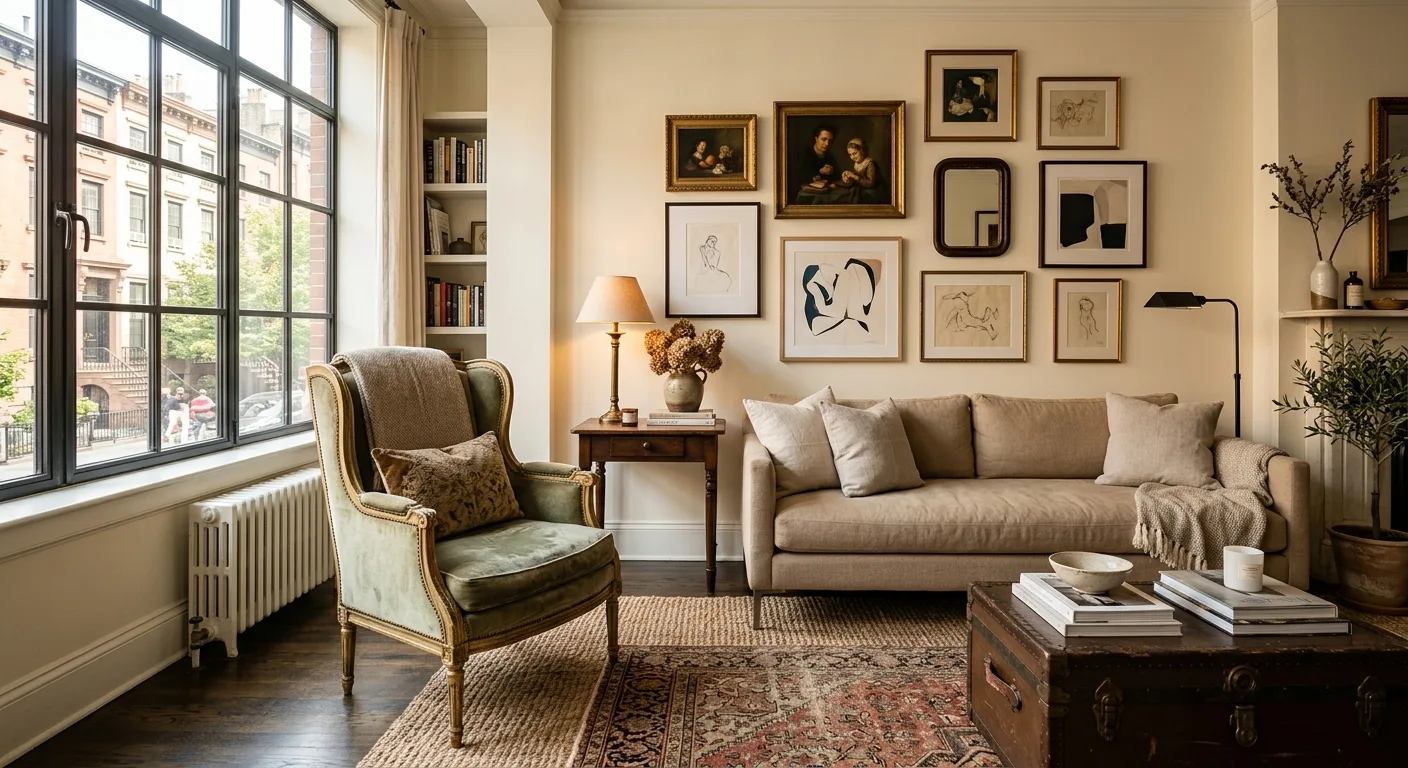
Fabric selection follows the same logic. Velvet remains the perennial choice for dining chairs and accent seating in New York interiors because high-quality velvet (particularly wool or mohair weaves) holds its pile under serious use and develops a distinguished patina. Performance textiles have improved dramatically and now belong in main living areas, particularly in households with children or pets, without compromising the visual register that clients expect from a refined interior.
The Role of Custom Work
One reason boutique residential firms operating in New York have retained their relevance against larger studios is their ability to deliver custom millwork and furniture at a scale that makes sense for a 900-square-foot apartment. A bespoke built-in that houses a television, conceals radiator covers, and provides integrated storage for books and objects is not an extravagance in Manhattan; it is often the only rational answer to a wall that would otherwise be either cluttered or barren.
Custom upholstery, similarly, allows a designer to specify a sofa scaled precisely to the depth of a particular living room, avoiding the proportional awkwardness of a standard 90-inch frame in a room where 82 inches would read correctly. This precision is invisible when it is done well, which is precisely the point. The occupant does not think about why the room feels resolved; they simply experience it as a space that works.
Light as a Design Material
New York apartments are defined by their light conditions as much as by their architecture. A south-facing unit in a post-war tower on the Upper East Side has an entirely different design vocabulary available to it than a north-facing apartment in a brownstone on a narrow block in the West Village. Skilled designers treat light not as a backdrop but as a primary material.
Window treatments in a light-challenged room should do two things: maximize daylight penetration when open and provide genuine privacy and warmth when drawn. Sheer linen panels that diffuse north light gently are preferable to heavy drapery that simply darkens the room further. In a sun-drenched south-facing apartment, the challenge reverses: materials need to absorb rather than reflect, and the palette benefits from cooler, more recessive tones that prevent the interior from feeling washed out at midday.
Artificial lighting layers (ambient, task, and accent) are too frequently treated as an afterthought. In a well-designed New York apartment, the lighting plan is developed in parallel with the furniture plan, not after it. Ceiling heights determine whether recessed fixtures are feasible or whether surface-mounted and pendant solutions are more appropriate. In pre-war apartments with plaster ceilings that cannot be penetrated without significant cost, a thoughtful combination of table lamps, floor lamps, and discreet wall sconces can produce the same layered luminosity as a full recessed scheme.
Coherence Across a Full Residence
The apartment that reads as genuinely distinguished is one in which every room participates in a coherent interior language without becoming monotonous. A consistent material palette (perhaps three to four finishes that recur throughout) creates visual continuity as a person moves from room to room. Within that continuity, each space retains its own character: the library is quieter and more enveloping than the living room; the primary bedroom is softer and less architecturally assertive than the entry hall.
This coherence is the signature of the practiced residential designer. It is not achieved by purchasing a furniture collection and placing it room by room; it is achieved by understanding the full residence as a single composed piece, with its own rhythm, counterpoint, and resolution. In a city as demanding as New York, that level of care is what distinguishes an interior that endures from one that merely photographs well in the year it is completed.